Showing posts with label travel. Show all posts
Showing posts with label travel. Show all posts
BALI HONEYMOON
Thursday, 20 April 2017
SUSHI MAKING IN TOKYO
Wednesday, 16 November 2016
Posting a little out of order here, but I wanted to squeeze in a little food post as it's been a while! Hands down the best thing we did on our 'second honeymoon' in Tokyo was go to a sushi making class. My friend's boyfriend booked the four of us into a class at the Tokyo Sushi Academy in Tsukiji and the school's close proximity to Tokyo's fish market (seeing this was the second best thing to happen that day) meant we had our pick of some of the world's freshest fish!

WEEKEND IN RYE
Monday, 25 July 2016

Rye is tiny and absolutely charming. We stayed at The Standard Inn in the middle of the Old Town and, although I gave it a slightly unfavourable TripAdvisor review (due to it being too hot, too noisy and absolutely tiny - not great value for money), it was a lovely place to spend a night. We'll just bring a fan next time!
We spent an hour or so walking around the town - in the centre there is a small strip of antique shops which are mostly overpriced, but we couldn't resist a pair of large pink and yellow teapots at £10 a pop. We spent the evening dipping in and out of different pubs and had our dinner at The Standard, who offer a bit more than your standard pub grub; I had delicious scallops with a gratinated garlic and herb crumb and Darren had the most amazing chicken pie I've ever tasted, packed full of fresh chicken. A mini break breakfast is always something I look forward to and The Standard didn't disappoint with a really great full English, yoghurt and Dorset Cereals - just a shame we had to take breakfast in shifts as the dog was a bit restless and irked at having to watch us eat. Note to self: hotel may be dog-friendly, but bringing a dog isn't always hotel-friendly! I think we will wait until he is a bit older before trying that again.


PRACTICAL TIPS FOR VISITING JAPAN
Monday, 19 October 2015

I lived in Japan from the age of 10 to 14 but visiting as an adult and a tourist was such an incredible experience. I felt lucky to have a loose grasp on the language and understand a few of the cultural norms and expectations, but I saw everything with fresh eyes, completely as a foreigner instead of an expat (can a child be an expat?).
I am by no means an expert, but I thought I'd offer some practical advice if you're ever thinking of visiting Japan.

GETTING THERE
Direct flights to Japan are expensive, which was always my reason for not wanting to visit. We got flights with a short stopover in Istanbul through Turkish Airlines for £400! I still can't get over it. Not only did we save £600 each, the flights and transfers went without a hitch, our luggage reached its destination, the entertainment was good and the food was seriously impressive - especially the meals on our flight back from Japan. I would seriously recommend checking them out if you're planning any long haul trips as they fly to loads of destinations around the world.

GETTING AROUND
If you're entering Japan on a tourist visa and planning to travel a bit when you're there, then it's worth looking into a JR Pass, which offers unlimited train travel for a fixed price. The pass is pricey, but a one week pass costs the same as a return ticket from Tokyo to Kyoto so any airport transfers, day trips and certain subway lines within Tokyo during those 7 days would be free.
At first glance, the Tokyo subway system is a bit mental, but it's sort of logical once you get the hang of it, though signs aren't always in English and as there are a few privately run train providers, it's not always clear how to change between them. Download the Tokyo Subway Navigation app - it's free and it works offline, but it only covers lines run by the Metro system.
PORTABLE WIFI
Technology-wise, the Japanese think of everything and portable wifi is the most genius invention. It's smaller than a phone, so fits easily into a handbag or pocket, and is invaluable for looking up maps or restaurant recommendations. We reserved and prepaid for one online, which we picked up at the airport post office, but there's also a place to rent them inside the Narita airport train station (and I'm sure there would be at Haneda as well). We rented the wifi for a week, while we were travelling around Kyoto, and then returned it when we got back to Tokyo as our Airbnb came with one, which seemed to be a standard at all the apartments I looked at.

WHERE TO STAY
We stayed in this apartment through Airbnb and loved that we could live like locals, do laundry, wake up late and save A LOT of money, but we also treated ourselves to two nights in a hotel at the end of our trip. Hotels are expensive in Tokyo but if it's your first time in Japan it might be nice to stay in a hotel when you arrive to get your bearings. Booking.com is great for getting the best deal; I like to book a few rooms in different hotels as you don't have to pay upfront and there's usually no cancellation fee (though make sure you check as it varies from hotel to hotel), so you can pick where you went to stay up until the last minute. We liked the Mitsui Garden Premier Hotel Ginza for its great views, big bathroom and central location.

WHAT TO EAT
Of course I'm not going to tell you what to eat! Eat everything! But I just thought I'd round up a few things to be aware of. Usually, Japanese restaurants only serve one type of thing, so it's worth discussing with your travel buddy what you really want to eat and what you're not that bothered about; there are certain things I love that Darren wasn't keen on, so I was happy to grab a quick meal on my own on a few occasions!
Japan can be a tricky place for vegetarians as even seemingly innocent dishes like miso soup are often made with dashi, a stock made from kelp and dried bonito (fish) flakes, that forms the basis of many Japanese meals. It's worth doing a bit of research before you go if you don't want to end up eating anything with fish in it.


SPEAKING THE LANGUAGE
I was surprised by how little English people spoke...or wanted to speak! My Japanese is good enough to order food or ask for directions (though not always to understand the answers!) and I have a feeling it confused people when I would ask if they could speak English...in perfect Japanese. But that's as far as my Japanese goes. Japanese people often study English at high school, so I have a feeling that people are wary of saying they do speak English, and then not understand what you're talking about, so it's easier to say no. Saying that, Japanese people are unfailingly polite and are so kind and helpful; if they really don't understand English, they will still try really hard to answer your question. And lots of people are happy to practice...we actually had a few people come over to us and randomly start up conversations on seemingly random things.
The one instance where the language barrier can be a problem is when you're looking for a restaurant. If you don't know what the name of a restaurant looks like in Japanese, it could cause a bit of a problem, so try and look for a picture of the restaurant's sign if it's somewhere you're really set on going. We found it difficult to pick as place to eat when we hadn't planned where to go as signs and menus are usually in Japanese and a lot of the best 'hidden' restaurants have fabric over the doors so you can't see in and get a feel for what you might be stepping in to!

BATHROOMS
Japanese toilets deserve a blog post in their own right! They have electric toilets called Washlets which do everything from warm the seat and offer bidet functions to play music or flush sounds to disguise any embarrassing noises. You might find traditional squat toilets in some less advanced public bathrooms, like in parks, but for the most part public bathrooms have Western toilets and are almost always spotless - even in the train stations!
ETIQUETTE
Japanese people are unfailingly polite - they see you out of their restaurants with a wave, sometimes standing outside until you eventually turn a corner, they hand everything to you with both hands as a sign of respect and they love a good queue as much as us Brits do.
Apart from the occasional sharp elbow when you're getting off the train, Japanese people are very aware of their actions and there are a few things they don't really do. Firstly, they don't eat on the train - except in the case of regional inter-city trains, where it's a big thing to get out your bento (packed lunch) and a few drinks and make a real occasion of it. Although I've seen people have a sneaky snack or a swig of a bottle of water, for the most part they really don't eat on the subway and certainly not a proper meal like a burger or a sandwich. Secondly, they only smoke in designated areas. There is widespread smoking in restaurants but, for the most part, people don't smoke while walking down the street and so you will find designated smoking areas with ashtray bins next to train stations. Take your cues from the people around you and you'll be just fine.

BUDGETING
For the first time ever, we came home with money leftover! Japan has a reputation for being one of the most expensive cities in the world, but coming from another of the world's most expensive cities, we were pleasantly surprised. Firstly and most importantly, we had a really good exchange rate of about ¥184 to £1, which makes the world of difference, so if you can plan your travel flexibly, wait for a time when your money will go that bit further.
Secondly, I suppose Darren and I have cheap taste! We love eating ramen, street food and going to izakaya bars, but if it is your first time visiting Japan then it's worth splashing out a bit of money to experience proper restaurant dining or visit one of the bars in Tokyo with a great view. Once you get there, you'll want to see and do everything, and if you have the means to do so then you should go for it because if Japan is very far away for you, you're unlikely to be going back again soon.
If you want to experience some nice meals, but you're on a budget, go out at lunchtime. It's amazing how the prices can change for the same thing - sometimes half the price! Then you can spend your evening in an izakaya being a bit more frugal.
As a guide, here are some rough prices for food and drink (as of September 2015!)
Ramen ¥800
Lunch set (tonkatsu, tempura, etc.) ¥1,700
Small plate in an izakaya ¥300 - ¥600
All you can eat yakinuku ('grill it yourself' meat) ¥2500 (you can find all you can drink too!)
Glass of beer ¥500 - ¥600
180ml serving of sake ¥800
Glass of umeshu/shochu cocktail ¥400
Soft drink ¥400

#SPRUNTINGINJAPAN: ginza, tsukiji + shimbashi
Wednesday, 14 October 2015
Since we saved a lot of money by staying in an Airbnb, we moved to a plush hotel for the last two nights of our trip. We booked a late night flight on the Sunday, so it was nice to be able to leave our suitcases at the hotel while we explored and have a nice lobby to hang out in before going to the airport.


We got a ridiculously great deal on the Mitsui Garden Hotel Premier Ginza thanks to Booking.com and we loved the amazing view from our (teeny tiny, but super luxe) room. The hotel is at the south end of the main Ginza high street, literally two minutes' walk from Shimbashi station. In the end, this suited us a lot better as Shimbashi has its own unique environment. While Ginza is home to fancy shops and smart restaurants, Shimbashi seems to be the place all the city workers go to for lunch/after work shenanigans, due to its close proximity to Shiodome, the Canary Wharf of Tokyo. This means it's home to lots of standing ramen and udon bars and late night haunts.
After eating so much rich food for the past two weeks I was craving something simpler and I got my fix in the form of a hot bowl of udon for ¥350 (about £1.80!). Kitsune udon is one of my favourite things in the world and something I'm sad not to really see in London. The udon comes in a steaming dashi broth that I will definitely be making at home and comes topped with a sort of squidgy mattress of sweet, deep-fried tofu skin and a spoonful of crispy tempura 'crumbs'. And yes, I slurped it!


Ginza itself is a cool place to visit at the weekend; they close off the main street to cars so there's plenty of space to roam around. The only problem is it's full of Chinese tour groups which isn't a problem per say, except that they arrive in big tour buses and as a result are quite often clogging up the pavement waiting for their buses to pick them up again! Anyway, Ginza is home to the world's largest Uniqlo as well as Itoya, an incredible stationery department store which just got a new home on the main strip. My friend said the area is constantly changing and they seem to be knocking down buildings left, right and centre just to build new homes for the same shops!


Ginza is also home to the national kabuki theatre, Kabuki-za. This traditional form of Japanese theatre features an all-male cast and you can get tickets on the day for a single act, which is popular with tourists as you can get a taster for kabuki and just watch for an hour, instead of the usual 4+ hours. The new theatre, opened in 2013, was spectacular and less than 10 minutes walk from our hotel.


The world-famous Tsukiji fish market is also just a short walk from Ginza. The market is due to move outside of Tokyo soon, so we were glad to be able to visit, though we didn't go at the crack of dawn like some tourists do in the hope of getting in to see the famous tuna auctions. Instead, we just enjoyed wandering through the streets and had a delicious breakfast of sashimi-don. While you might be expecting to find lots of sushi here - and there is - don is also a traditional way to eat sashimi, simply served in a bowl on top of sushi rice. We went to a different place to the picture below, where we had big servings of fatty tuna and salmon for only about ¥1000 (about £6).


Tamagoyaki, a Japanese omelette made in the shape of a large brick using a special pan, is a lesser-known part of the sushi experience (in the UK, at least), but it's a vital part of any sushi master's repertoire and striking the perfect balance between flavour and texture is an art that takes time to perfect.
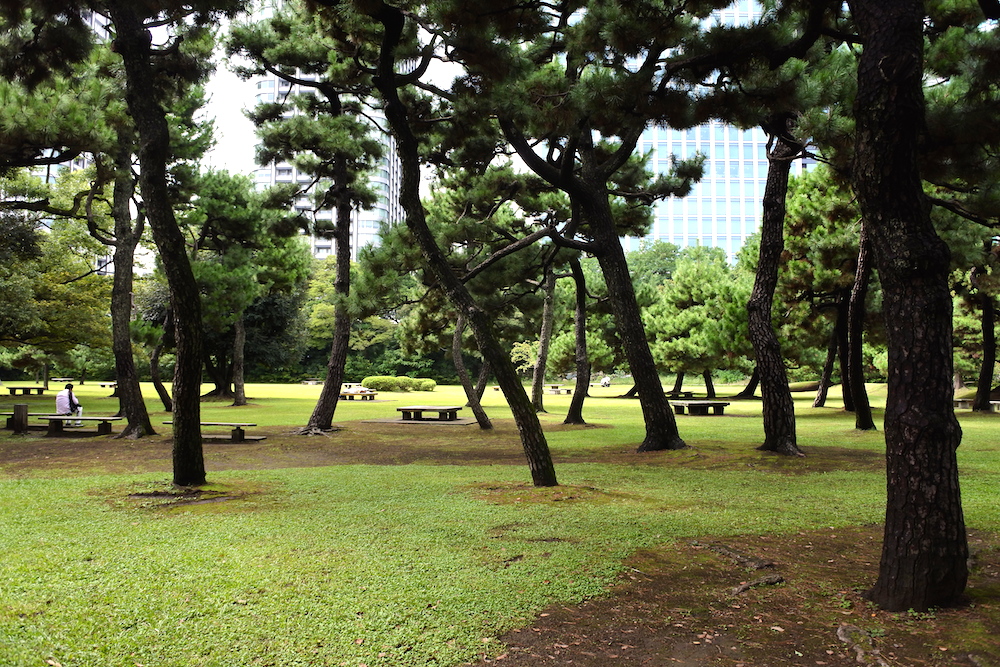
As I said before, the nearby Shiodome area is Tokyo's answer to Canary Wharf, so it was surprising to find the beautiful Hamarikyu Gardens nestled amongst the skyscrapers. Located at the edge of Tokyo Bay, the landscaped park features beautiful flower gardens and a unique saltwater pond home to plenty of fish you wouldn't usually see in a park! It felt very zen being there and is now probably one of my favourite Tokyo landmarks.


I'm about to wrap up this super long post and, actually, this is the last of my Tokyo neighbourhood posts! But first I have to tell you about one last place: Go Go Curry. Japanese curry is a strange and wonderful thing - thick, sweet, salty. I don't know. It's hard to describe but it's probably not like anything you've had before...if you've been to Wagamama and had the katsu curry then you might have an idea, but it really is an experience! We kept seeing a chain of shops called Go Go Curry (there's even a branch in NY that calls it Japan's No. 1 curry!), with a distinctive gorilla logo, and joked that it looked bizarre. So of course we had to try it and lo and behold! It actually turned out to be one of my favourite meals. There was this weird moment where I took the first bite and thought it was so grim, but the more I ate, the more I got into it. Maybe we were a little drunk - and it's definitely the equivalent to a late night kebab, rather than a special meal out - but it was smiles all round for this greedy bear!


Did you make it this far? Thank you for reading! I'm sad my Japan posts are pretty much done, but I have one last post scheduled for Monday with a few tips about visiting Japan so make sure to check that out if you're interested!
We got a ridiculously great deal on the Mitsui Garden Hotel Premier Ginza thanks to Booking.com and we loved the amazing view from our (teeny tiny, but super luxe) room. The hotel is at the south end of the main Ginza high street, literally two minutes' walk from Shimbashi station. In the end, this suited us a lot better as Shimbashi has its own unique environment. While Ginza is home to fancy shops and smart restaurants, Shimbashi seems to be the place all the city workers go to for lunch/after work shenanigans, due to its close proximity to Shiodome, the Canary Wharf of Tokyo. This means it's home to lots of standing ramen and udon bars and late night haunts.
After eating so much rich food for the past two weeks I was craving something simpler and I got my fix in the form of a hot bowl of udon for ¥350 (about £1.80!). Kitsune udon is one of my favourite things in the world and something I'm sad not to really see in London. The udon comes in a steaming dashi broth that I will definitely be making at home and comes topped with a sort of squidgy mattress of sweet, deep-fried tofu skin and a spoonful of crispy tempura 'crumbs'. And yes, I slurped it!
Ginza itself is a cool place to visit at the weekend; they close off the main street to cars so there's plenty of space to roam around. The only problem is it's full of Chinese tour groups which isn't a problem per say, except that they arrive in big tour buses and as a result are quite often clogging up the pavement waiting for their buses to pick them up again! Anyway, Ginza is home to the world's largest Uniqlo as well as Itoya, an incredible stationery department store which just got a new home on the main strip. My friend said the area is constantly changing and they seem to be knocking down buildings left, right and centre just to build new homes for the same shops!
Ginza is also home to the national kabuki theatre, Kabuki-za. This traditional form of Japanese theatre features an all-male cast and you can get tickets on the day for a single act, which is popular with tourists as you can get a taster for kabuki and just watch for an hour, instead of the usual 4+ hours. The new theatre, opened in 2013, was spectacular and less than 10 minutes walk from our hotel.
The world-famous Tsukiji fish market is also just a short walk from Ginza. The market is due to move outside of Tokyo soon, so we were glad to be able to visit, though we didn't go at the crack of dawn like some tourists do in the hope of getting in to see the famous tuna auctions. Instead, we just enjoyed wandering through the streets and had a delicious breakfast of sashimi-don. While you might be expecting to find lots of sushi here - and there is - don is also a traditional way to eat sashimi, simply served in a bowl on top of sushi rice. We went to a different place to the picture below, where we had big servings of fatty tuna and salmon for only about ¥1000 (about £6).
Tamagoyaki, a Japanese omelette made in the shape of a large brick using a special pan, is a lesser-known part of the sushi experience (in the UK, at least), but it's a vital part of any sushi master's repertoire and striking the perfect balance between flavour and texture is an art that takes time to perfect.
As I said before, the nearby Shiodome area is Tokyo's answer to Canary Wharf, so it was surprising to find the beautiful Hamarikyu Gardens nestled amongst the skyscrapers. Located at the edge of Tokyo Bay, the landscaped park features beautiful flower gardens and a unique saltwater pond home to plenty of fish you wouldn't usually see in a park! It felt very zen being there and is now probably one of my favourite Tokyo landmarks.
I'm about to wrap up this super long post and, actually, this is the last of my Tokyo neighbourhood posts! But first I have to tell you about one last place: Go Go Curry. Japanese curry is a strange and wonderful thing - thick, sweet, salty. I don't know. It's hard to describe but it's probably not like anything you've had before...if you've been to Wagamama and had the katsu curry then you might have an idea, but it really is an experience! We kept seeing a chain of shops called Go Go Curry (there's even a branch in NY that calls it Japan's No. 1 curry!), with a distinctive gorilla logo, and joked that it looked bizarre. So of course we had to try it and lo and behold! It actually turned out to be one of my favourite meals. There was this weird moment where I took the first bite and thought it was so grim, but the more I ate, the more I got into it. Maybe we were a little drunk - and it's definitely the equivalent to a late night kebab, rather than a special meal out - but it was smiles all round for this greedy bear!
Did you make it this far? Thank you for reading! I'm sad my Japan posts are pretty much done, but I have one last post scheduled for Monday with a few tips about visiting Japan so make sure to check that out if you're interested!
#SPRUNTINGINJAPAN: ueno, kappabashi kitchen town + akihabara
Monday, 12 October 2015
Up in the north east of Tokyo, there are a cluster of neighbourhoods around the Ueno area that we loved. First of all, there's Ueno Park. The park is huge and home to a few museums, making it a cultural hotspot. It was a national holiday while we were there and we found a huge pottery market in the square, where we picked up a few cheap dishes and bowls. I love the pictures below - Darren is smiling because we'd just started looking, but it was really hot and there was zero air circulating, so in the next picture I'm pretty sure he's going 'just pick one'.


 We found this cute panda postbox outside the zoo, which is inside the park. The zoo was seriously cheap (¥600) so we should have known it wouldn't be great. It's a nice zoo with plenty of open spaces for larger groups and families to hang out and enjoy, but on the whole we found the enclosures a bit sad and realised how great London Zoo really is. The best part of the zoo, for me, ended up being the giant lily pond, which is home to the lemurs, who probably got the best deal in the park.


About 10 minutes' walk from Ueno station you come to a giant chef's head on top of a building, which marks the start of Kappabashi-dori - also known as kitchen town. This is, as you might imagine, a whole street full of shops selling everything you could possibly need for cooking, from traditional Japanese utensils and crockery to some of the world's best knives and the lanterns you find hanging outside ramen shops. Apparently, both home cooks and restauranteurs alike shop here, but we found it to be expensive. I came away with a copper egg pan used for making my favourite tamagoyaki, which I noticed (smugly) was more expensive everywhere else we saw it.


Not far from Ueno, there's a neighbourhood called Yanaka with a kind of old town vibe. You can get a beer from the local shop and sit on a crate outside, snacking on croquettes from nearby stalls. We stopped by for a quick drink with my friend Ayumi before going on to a local temple. During national holidays, many temples in Japan have little festivals where they set up food stalls and games and people flood in to eat, chat and play. This ended up being one of my favourite evenings in Tokyo thanks to the festive atmosphere and cheap, tasty eats.


About 10 minutes' walk from Ueno station you come to a giant chef's head on top of a building, which marks the start of Kappabashi-dori - also known as kitchen town. This is, as you might imagine, a whole street full of shops selling everything you could possibly need for cooking, from traditional Japanese utensils and crockery to some of the world's best knives and the lanterns you find hanging outside ramen shops. Apparently, both home cooks and restauranteurs alike shop here, but we found it to be expensive. I came away with a copper egg pan used for making my favourite tamagoyaki, which I noticed (smugly) was more expensive everywhere else we saw it.
A few stops away on the subway there's another mecca for another type of fanatic altogether. Akihabara is world-famous for being the home of department stores for electronics, shops devoted to comics, anime figurines and collectibles and, of course, maid cafes. We heard a place called Nakano Broadway is actually a lot better for anime and manga collectors - Darren's a fan - but Akihabara is easily accessible and I was happy not to go to looking for anymore nerd shops (sorry, Darren!).
Not far from Ueno, there's a neighbourhood called Yanaka with a kind of old town vibe. You can get a beer from the local shop and sit on a crate outside, snacking on croquettes from nearby stalls. We stopped by for a quick drink with my friend Ayumi before going on to a local temple. During national holidays, many temples in Japan have little festivals where they set up food stalls and games and people flood in to eat, chat and play. This ended up being one of my favourite evenings in Tokyo thanks to the festive atmosphere and cheap, tasty eats.
Subscribe to:
Posts (Atom)